

Digital marketing can feel like a maze — SEO here, ads there, funnels everywhere. But underneath all the jargon, it’s just a simple process for connecting your business to the right people online. Whether you’re a small business owner or just starting out, understanding how digital marketing actually works step by step can save you time, money, and stress.
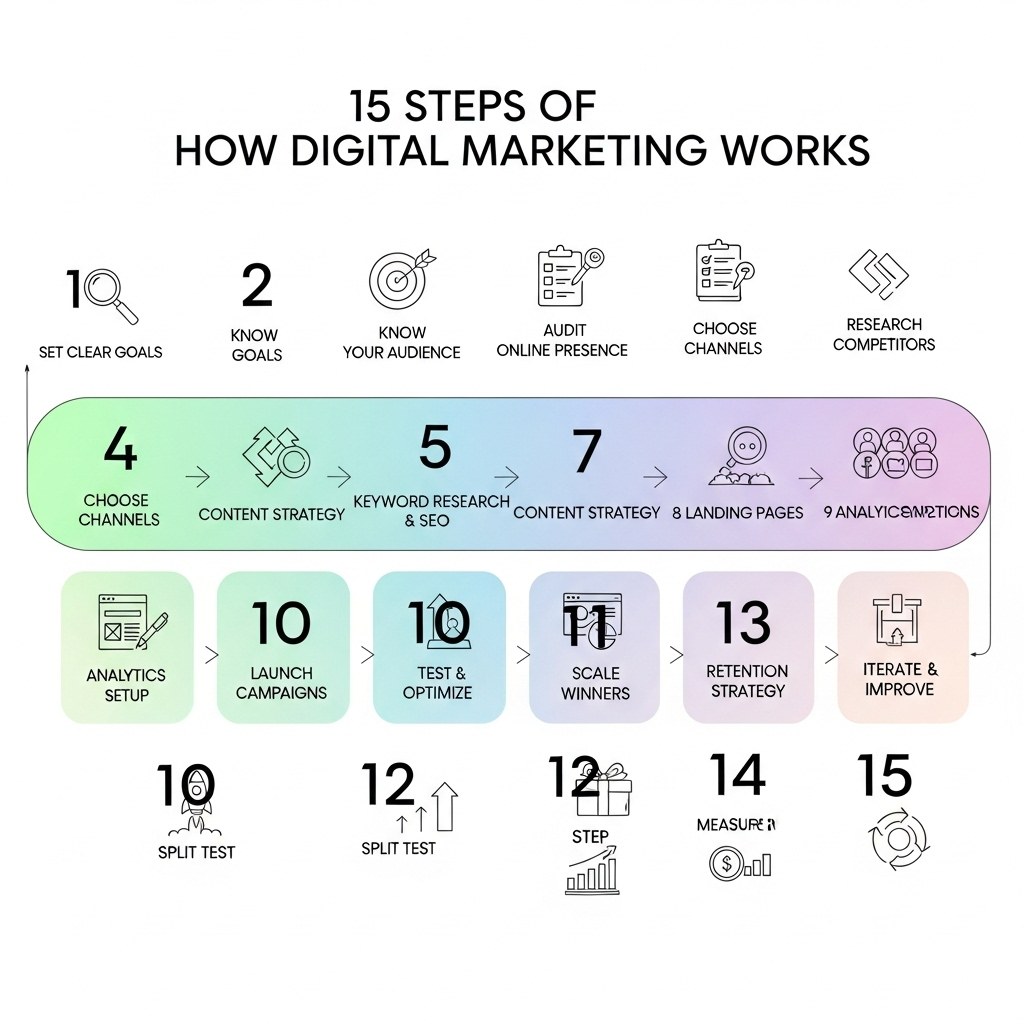
Step 1: Set Clear Goals
Before you dive in, ask yourself: what does success look like? More sales, more leads, more website traffic? Defining your goals upfront makes every decision easier.
Quick tip: Make your goals specific and measurable (for example, “200 new leads per month” or “increase sales by 20% in 6 months”).
Step 2: Know Your Audience
Digital marketing starts with knowing who you’re talking to. Build simple buyer personas — little profiles of your ideal customers, including their age, location, interests, and pain points.
When you understand your audience, your ads, content, and emails become far more effective.
Step 3: Audit Your Current Online Presence
Check your website, social media accounts, email list, and online reviews. Is your website mobile-friendly? Do your social profiles look active? This audit helps you see what’s already working and what needs fixing.
Step 4: Research Your Market and Competitors
Look at what other businesses in your niche are doing. Which platforms do they use? What kind of content works for them? Learning from your competitors’ successes and mistakes can speed up your own progress.
Step 5: Choose the Right Channels
You don’t need to be everywhere. Pick 1–2 channels where your audience spends the most time. For example:
- SEO + blogging for long-term, free traffic
- Instagram or Facebook for visuals and community
- LinkedIn for B2B services
- Paid ads for fast, targeted reach
Start small and do it well before expanding.
Step 6: Do Keyword Research and Set Up SEO Basics
Search engines are still the #1 way people find businesses. Use free tools like Google Keyword Planner or Ubersuggest to find keywords your customers use. Optimize your website titles, meta descriptions, and content to match those terms.
SEO takes time but pays off with steady, low-cost traffic.
Step 7: Create a Content Strategy
Content is the engine that drives digital marketing. Plan what you’ll post (blogs, videos, social posts, emails) and when. Map your content to your customer’s journey: awareness, consideration, decision.
Tip: Repurpose one idea into multiple formats — a blog post can become a LinkedIn article, a short video, and an Instagram carousel.
Step 8: Build Conversion-Focused Landing Pages
Traffic is useless if visitors don’t take action. Create landing pages with:
- Clear headlines
- Benefits and proof (reviews, testimonials)
- A single call-to-action (buy now, sign up, book a call)
This turns clicks into leads and sales.
Step 9: Set Up Tracking and Analytics
Install Google Analytics, Facebook Pixel, or similar tools to see who’s visiting your site and what they’re doing. Without tracking, you’re marketing blind.
Measure at least traffic, leads, conversion rate, and cost per acquisition.
Step 10: Launch Campaigns (Organic + Paid)
This is where you start running ads, posting content, and emailing your list. Test small campaigns first — a single ad set, one email offer, or one content series — then adjust based on results.
Step 11: Test and Optimize
Digital marketing thrives on testing. A/B test your headlines, images, calls-to-action, and ad copy. Keep the winners, kill the losers. Small improvements in conversion can multiply your revenue.
Step 12: Scale the Winners
Once you find something that works, pour more resources into it. Increase your ad spend, expand to new audiences, or replicate your funnel on another platform. This is how you move from modest results to serious growth.
Step 13: Focus on Retention and Lifetime Value
Acquiring customers is expensive — keeping them is where the profit is. Use email marketing, remarketing ads, loyalty programs, and great customer service to encourage repeat purchases.
Loyal customers cost less and spend more over time.
Step 14: Measure ROI Regularly
Check your numbers weekly or monthly: traffic, conversion rates, cost per lead, and return on ad spend (ROAS). Tie your marketing efforts directly to sales so you can see which activities pay off.
Step 15: Iterate and Improve
Digital marketing isn’t a one-off project — it’s an ongoing cycle. Use what you’ve learned to refine your audience targeting, creative, and channel mix. Stay curious and keep testing.
Putting It All Together
Think of digital marketing like building a machine:
- You identify your audience.
- You attract them with content and ads.
- You convert them with great offers and landing pages.
- You retain them with email and loyalty.
- You track everything and improve it over time.
This process is the same for a small business or a large corporation — the difference is scale and budget.
Quick KPI cheat sheet
Traffic = total visitors
CTR = click-through rate (ads, emails)
Conversion rate = % who take your desired action
CPA = cost per acquisition
CAC = customer acquisition cost
LTV = lifetime value of a customer
ROAS = return on ad spend
Copy-paste starter checklist
- Define 1 business goal.
- Create 1 buyer persona.
- Audit website + analytics.
- Pick 1 channel to start.
- Publish 1 piece of content + 1 ad test.
- Track results and run 1 A/B test.